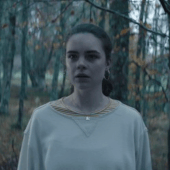
Egghead Republic had its UK première at Glasgow Film Festival, 4 Mar 2026
What is the wellspring of an artist’s talent? Is it in the blood? or perhaps in the brain? or is it an accretion of experiences? or is it a strange power – empathetic or otherwise – to get into another person’s head? At the beginning of Pella Kågerman and Hugo Lilja’s Egghead Republic, Sonja Schmidt (Ella Rae Rappaport), herself an aspiring artist, watches a DVD interview with Bob Singleton (Stephen Rappaport), a controversial and now reclusive Nobel Prize-winning author, who shares his wisdom on the topic. “In order to create exceptional works, one must put oneself in an exceptional frame of mind,” Bob says, staring into the camera, “You cannot tell a story without experiencing it yourself.”
Sonja is herself an aspiring if rather unknown artist, whose main claim to fame is entirely second-hand: she is the great niece of the late great writer Arno Schmidt (which is also the name of the author from whose novel The Egghead Republic this film has been freely adapted). In fact her one piece of celebrated public art is a sketch she drew aged four which Arno put on the cover of a novel – but she never really knew the man. Nonetheless that genetic connection has earned Sonja an invitation from Bob Singleton himself – a big fan of Arno’s work – to come visit the Institute for Radiation Arts and Sciences (IRAS), a commune for thinkers and creatives located on the edge of a walled-off, highly radioactive Zone in Kazakhstan.
The Kalamazoo Herald, a VICE-like publication that sends drunk, drugged-up gonzo journalists to trouble spots to capture, or at least create, chaos on camera, is keen to be the first media group to get access to IRAS and the Zone, which have been shrouded in mystery. So Kalamazoo’s dissolute, womanising owner Dino Davis (Tyler Labine) sees Sonja as his ticket, and asks her to join himself and videographers Turan Hiram (Arvin Kananian) and Gemma (Emma Creed) to make a film there. Sonja knows that she is being exploited, but hopes in turn to launch her own career with a prestigious gig as illustrator for Kalamazoo – although as she will soon discover, she will have to vie with her other colleagues for Dino’s fickle attention. Here everybody wants something – and Dino, who already has everything apart from self-respect, gets everyone else dancing to his tune. He is in a privileged position of being able to change the world for the better, but instead pursues only his own narrowly appetitive thrills and self-interests.
In Andrei Tarkovsky’s Stalker (1979), people travel illegally into a forbidden Zone, seeking a Room at its centre said to grant those who enter their deepest desire. The Zone in Egghead Republic has a similar function – a supposedly dangerous locus of the illusory and the impossible, its bare rocky landscapes exposing intruders to who they really are and what they really want. Sonja certainly goes in with ambitions, but also with little focus. She knows that she wants to be an illustrator, but has no patience for schooling and is currently serving more as Dino’s on-camera sidekick and foil than as an artist, while taking all the drugs he feeds her despite their obviously deleterious effect on her health and ability to function. And while everyone hassles her for sex, really bisexual Sonja would rather just be making out with a (female) centaur (Soltani Boljak Sara). Which is to say that Sonja’s dreams and fantasies are at variance with her reality – except in the Zone.
“We’ve got to keep the cameras rolling all the time, we’ve got to catch that gold, we’ve got to stay loyal to reality,” Dino tells his crew – yet reality here proves hard to pin down. For this is an alternative 2004, when the Cold War is still very much going (and occasionally ‘Hot’), and when even Schmidt’s 1957 novel will prove an unreliable map to where the film is headed. Dino is less reality’s obedient servant than its manufacturer and manipulator, and those working with him are more or less happy to play to the camera and to fabricate their material. In a sense it does not matter what is in the Zone, just so long as these reporters can construct and trademark a good story of their own about it – but the Zone itself, and IRAS too, will prove elusive and not at all what they purport to be, in a place where truth is disguised, genetics are passed on, consciousness is transferred, perspectives are shared and identity is fluid. This place, for all its surreal humour, is a testing ground for what it truly means for reportage and reality, art and identity, to be mediated and meet at the border. Meanwhile we viewers, like Sonja and her fellow journalists, observe vicariously, try to immerse ourselves in whatever is unfolding, and adopt the points of view of others, even as we too are mutated, hybridised and transformed by the film’s art.
strap: Pella Kågerman and Hugo Lilja’s gonzo sci-fi explores the illicit cross-border traffic between art and science, reportage and reality
© Anton Bitel