
Olha Savchenko is a student and member of The Centaurs, an experimental (yet practical) workshop established in 2024, during wartime, by Ukrainian filmmaker Dmitriy Tomashpolskiy at the Institute of Screen Arts of in Kyiv National I. K. Karpenko-Kary Theatre, Cinema and Television University. Centaurs like Savchenko adapt classical myths or literary works into short films, as a cri de cœur for humanist expression even while Kyiv is under constant Russian bombardment and at risk of dehumanisation.
Sonus ex Machina (2025)

Sonus Ex Machina (2025) is adapted from Roald Dahl’s short story The Sound Machine (1949), and although it changes the names and in one case the sex of the dramatis personae, it broadly adheres to the story’s plot, before introducing an ending that is explosively contemporary.
The mad scientist Klausner from the original is now Lonia (Artem Shteynle), and he is visited not by a Doctor, but by his friend Lina (Anastasia Yaroshuk), who is checking in on him, ostensibly to see if he has recovered from a cold. Lonia is distracted by his obsessive work on a device designed to pick up audio frequencies beyond human hearing. “It’s about things that are beyond our ability to perceive,” Lonia tells Lina – and in his experimental research, he has insulated himself from the attentions and obvious interest of Lina, and from the outside world in general. Yet even his device will open him to uncomfortable realities all around.
When Lonia takes his device outside to test it, he will, like Klausner in the short story, accidentally discover that plants emit an ultrasonic scream of pain when their leaves are torn off. This is an alarming realisation of invisible suffering which triggers in Lonia a desire both to verify his findings with someone else, and to heal the damage that his experiment has inadvertently done to the surrounding fauna (he insists over the phone that Lina bring bandages, brilliant green iodine and painkillers, presumably for the scarred trees). Yet when Lina comes and dons the headphones, what the sensitive device lets her hear is something equally inaudible, and equally damaging, in today’s beleaguered Kyiv.
Savchenko has taken Dahl’s post-war story and turned it into a mid-war one, as she finds a literary frame to capture the invisible sufferings of a city under constant siege – and so what starts as a portrait of an ordinary if eccentric life ends up revealing a new kind of everyday horror in Ukraine from which no one can seal themselves hermetically.
You can watch Sonus ex Machina here.
Invisibility (2026)
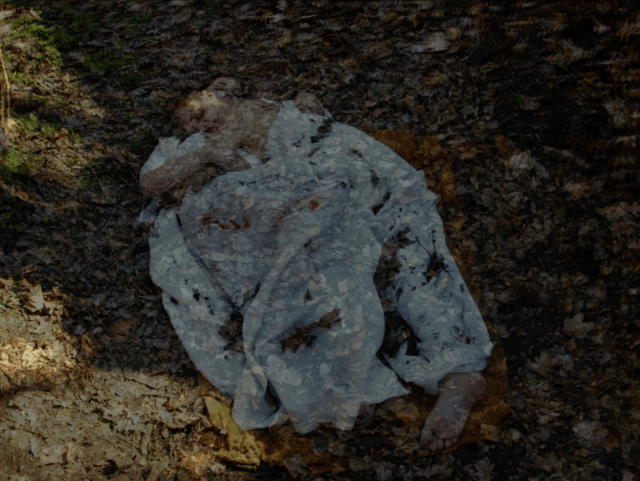
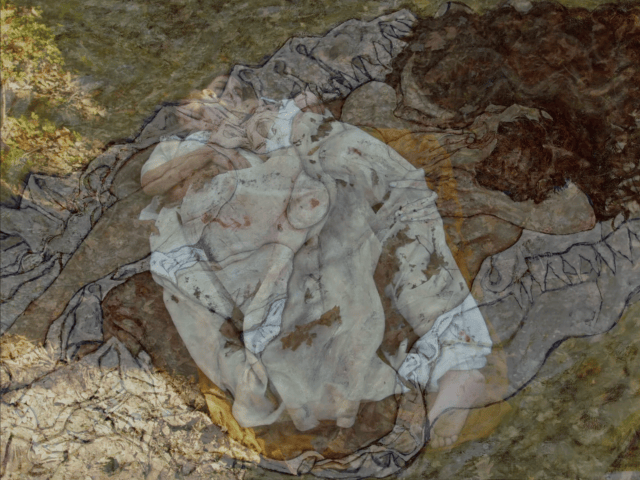
Shifting from inaudibility to invisibility, Savchenko here expressly adapts H.G. Wells’ novel The Invisible Man (1897), but the adaptation is free, self-conscious, even postmodern, slowly revealing a story of hidden love. For here we have an invisible woman, Dasha (Anastasia Yaroshuk again), who has her own copy of Wells’ novel in her apartment. While her own private research, conducted in her bedroom, will lead to a chemical compound that turns those who drink it invisible, she claims to have been already invisible from an early age, as someone whose dermal sensitivity to sunlight prevents her, vampire-like, from leaving her apartment, and from engaging in the social interactions that others take for granted.
At the insistence of her mother (Tetiana Sydorchuk), Dasha is a homebody and a shut-in, experiencing the outside world for the most part remotely through her window. Since her early childhood (she is played as a little girl by Sofiia Bilavchuk), her eye has been drawn to Edik (played as a child by Tair Hazizov), who has also paid a certain attention to her. In a for her uncharacteristic act of reaching out, the adult Dasha will try to lend her copy of The Invisible Man to her upstairs neighbour Edik (Zakhar Shestiaev). In this (for her) uncharacteristic act of reaching out to somebody else, Dasha tells Edik that the book is “about a man who turned invisible and tried to change something.” At the same time, Dasha’s experimental serum literalises her metaphorical invisibility, while implicitly allowing her to venture outside during the day by denying the sun any surface to incinerate. When she sees Edik with another woman, Valia (Iryna Zhydkova), Dasha concocts a plan to make her rival disappear so that she can find her own way at last into Edik’s arms.
Invisibility is shot mostly in monochrome, to reflect Dasha’s sun-free view of the world – and her own apartment is notably shadier than Edik’s upstairs, so that his eventual arrival in her bedroom is also a descent into darkness (or at least into the cocoon-like world of an agoraphobic introvert). By contrast the short’s closing images come in full colour. These show the couple in all their invisibility being beaten, possibly to death, by both Dasha’s mother and her rival, who have both in different ways been obstacles to the couple’s togetherness. The embracing couple also resolves, finally, into Egon Schiele’s 1917 painting The Embrace. This ending, visually discrete from the rest of the film and figured as a dream, sees Dasha and Edik outdoors together, not only merging with the violent ‘finale’ of Well’s novel, but also literally becoming art – and being adapted, reflexively, into a different medium. In the meantime, the couple’s adventures are accompanied by the ironising three-step of Cosmo Sheldrake’s score, whose jaunty geometries capture the bizarre love triangle at the film’s centre.
Invisibility is an elusive, enigmatic piece, as though its secrets have not all been quite made visible, and are being kept from prying eyes – but there remains, in this clash of romance and horror, the hint that what we are seeing is an imprisoned woman’s literature-inspired fantasy of amour and escape from her enclosing environs.
You can watch Invisibility here.
strap: Sonus ex Machina (2025) & Invisibility (2026): two short genre films made by Olha Savchenko under the aegis of the Centaurs workshop, and under Russian bombardment
© Anton Bitel


