
Erie world première at Beyond Fest, 1 Oct 2026
“During the summer of 1999, the town of Erie, Pennsylvania experienced an unusually high number of deaths. The following video cassettes were found by police in the possession of one of the deceased. They have been released for investigative purposes only.”
This text which opens Erie is programmatic: for it is not just an announcement of ‘true crime’ veridicality, and a descriptor of the story’s specific time and place, but also conforms to the conventions of found footage horror, where what is shown purports to be ‘documentary’ materials shot by the characters within their own narrative. Even the timing of 1999 subtly allies this with the feature that kick-started the current, now decades-long run of found footage film, Daniel Myrick and Eduardo Sánchez’s The Blair Witch Project, which came out in the same year. It is as though we are being taken back to the old school, as, sure enough, characters are once again lost in the woods, during a pre-millennial period before smart phones existed. Yet director Alison-Eve Hammersley’s film will come to subvert its own form and breach its own grammar as it finds new ways to disorient viewers as much as characters.
The promise of the opening text that someone is going to be found dead alongside video footage seems almost instantly fulfilled. For a prologue shows Iris Scott (Aimee Paxton) out in the woods filming herself with a video camera alongside a tuft of blue iris – a flower that shares her name and her key characteristic. When she apparently sees someone or something approaching out of shot, she flees up a tall tree, and then falls to the ground, dying in front of her still-running camera. This death, ruled a suicide, is in fact the catalyst for everything else in Erie, as Iris’s sister, the wannabe investigative journalist Stella (Carly Stewart), returns home to Erie with her brother Oscar (Grant Crater) to make an amateur documentary about a concentrated rash of supposed suicides, including Iris’, in the woods north-east of the city.
“As locals with knowledge of the area and a personal connection to the case,” Stella says in a to-camera piece that Oscar keeps interrupting, “we hope to uncover the true nature behind these disturbing deaths.” The two formally headed tapes that we are watching purport to be what Stella and Oscar film on their single camera, which immediately raises the question of how the footage of Iris’ death could be included at the beginning of the first video – and although that question will eventually be answered, already the viewer is being wrongfooted, and senses that there is an element amiss in the very medium of this unfolding mystery, as though something unnerving and eldritch is peeking through the treeline and trying to break in.
Stella and Oscar have different motives for participating in this film, and constantly josh each other and bicker as siblings do – but the one thing that unites them in their quest, beyond Stella’s narcissistic ambition and Oscar’s desire for truth, is a shared grief that has gone largely unaddressed, and that will find unexpected expression through their videography, permeated as it is with overwhelming, ultimately inescapable sadness. Erie is, though, also a very funny film, not least when the pair hook up with Red (Ryan W. Garcia), who immediately injects an element of mercurial madness to the proceedings.
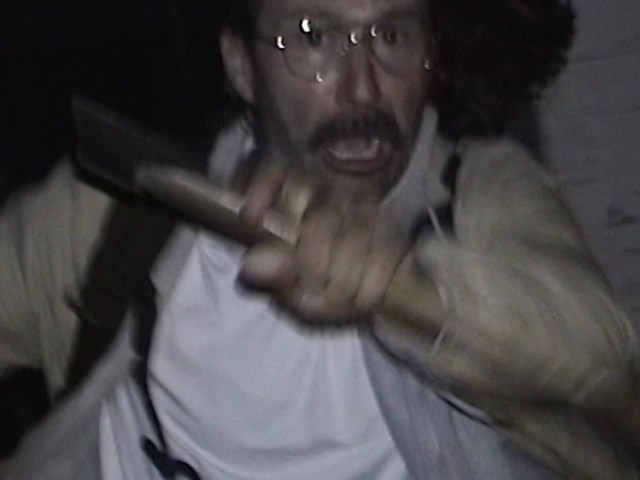
Red’s girlfriend Brenda was one of the alleged suicides, and Red, like the siblings, has been looking for answers – but he has prime suspect written all over him. If one of the deceased, David, lit himself on fire – an unconventionally agonising method of suicide, as Stella observes – and if Brenda is said, in shades of Demián Rugna’s demonic When Evil Lurks (Cuando acecha la maldad, 2023), to have struck herself multiple times with an axe, then there is a gas can sitting right outside Red’s woodland cabin, a hatchet placed prominently inside, and a life-sized doll of Brenda in his bedroom. No sooner has Red met the siblings in person than he picks up on Oscar’s nervousness and says with a smile and a laugh: “I could grab a machete and chop you up to bits if I wanted to, Jason-style”. And like Josef from Patrick Brice’s Creep (2014), Red just keeps popping up when least expected, sending a hilariously jumpy thrill through everything.
Part of what makes Hammersley’s screenplay, co-written with Jess Kohs, so uncanny is its overdetermination and the interpretative ambiguity that arises from this. On the one hand, the deaths may be, as the police have ruled them, simple suicides, and there is added, express speculation that these woods might be Pennsylvania’s answer to Japan’s ‘suicide forest’ Aokigahara. On the other hand, Red may be luring people to his hunting ground to murder them. Or it might be the effect of a toxin that has leached into the soil from a long-closed battery factory in the vicinity of the deaths. Or it might even be the work of a sasquatch or squonk, both explicitly namechecked.
What is clear, paradoxically, is that nothing is as it seems. Even the film’s pretence that what we are watching is exclusively intradiegetic footage will, at a certain point, be unceremoniously abandoned, so that the very format of Erie goes up for grabs. For the taped evidence turns out not to be all that there is to see, and soon not only will handheld found footage be intermixed with more conventional filmmaking, but ‘objective’ and ‘subjective’ camerawork will also become confused, as character’s dreams and escapist fantasies are placed on an equal footing with reality, whether mediated or unmediated. Amid all this narrative instability, an explanation of sorts, however irrational, will emerge, even as the reliability of anything and everything, including that explanation, is called into question. All this leaves us doubtful of the very tapes that we are investigating, unsure of the ground beneath our feet and unable to see the wood for the trees, and the resulting equivocations practically define e(e)rieness. Suicide, after all, is as mystifying and incomprehensible as it can be infectious, spreading its desperate sadness radially like the roots of a plant.
strap: Alison-Eve Hammersley’s sort-of found-footage feature debut makes a woodland mystery of suicide and sadness
© Anton Bitel

